

Baltic Birch Plywood: Buyer's Guide for Makers
Posted: October 21, 2026 in #Wood Nerds
Key takeaways
- Match thickness to the job: 1/8 in 5-ply for laser stock, 1/2 in 9-ply for cabinet boxes, 3/4 in 13-ply for workbench tops.
- Ply count is the fastest authenticity check: expect roughly 5-7 plies at 1/8 in, 9-11 at 1/4 in, and 13-15 at 3/4 in.
- True Baltic birch usually ships as 5x5 sheets, which are parcel-shippable and often cheaper per sheet than 4x8 freight orders.
- Expect roughly $30 to $120 per sheet depending on thickness, grade, and whether you buy 5x5 or 4x8.
- Big-box 'birch' plywood is usually veneer-core with filler strips, so count plies and check edges before buying.
Match the sheet to the job: 1/8 in, 5-ply for laser stock; 1/2 in, 9-ply for cabinet boxes; 3/4 in, 13-ply for workbench tops, all in 5x5 sheets unless you specifically need 4x8, at roughly $30 to $120 per sheet depending on thickness. This guide maps each use case to the right baltic birch plywood spec, then covers where to buy it and how to spot mislabeled sheets before they hit your machine.
Which Baltic birch plywood should you buy for your project?
Match the sheet to the job first, then check the ply count. Cabinet boxes want 3/4 in 4x8 sheets, 13 plies, edge-sanded so the laminations look clean on exposed edges. Workbench tops want 3/4, or two layers of 1/2 laminated face-to-face if you want extra mass and stiffness. Laser stock is 1/8 or 1/4 in smaller sheets, where 5-ply cuts fast and holds detail without charring the core.
Price moves with thickness and grade. Current US retail for 3/4 in 4x8 Baltic birch runs roughly $90 to $130 per sheet at suppliers like Boulter Plywood, with 1/4 and 1/8 sheets costing a fraction of that.
The 30-second decision table
| Project | Thickness | Plies | Sheet | Price band |
|---|---|---|---|---|
| Cabinet boxes | 3/4 in | 13 | 4x8 | $90–$130 |
| Workbench top | 3/4 or doubled 1/2 | 13 / 11 | 4x8 | $90–$130 |
| Laser stock | 1/8 or 1/4 in | 5 | 12x12 to 24x48 | $10–$50 |
How many plies should real Baltic birch have at each thickness?
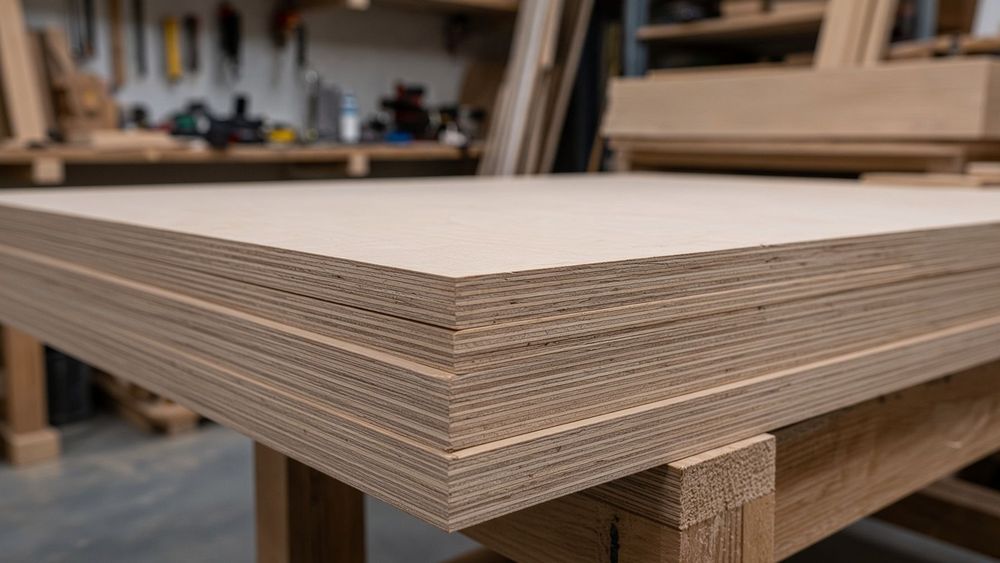
Ply count is the fastest tell for genuine Baltic birch. Expect roughly 5-7 plies at 1/8 in, 9-11 at 1/4 in, and 13-15 at 3/4 in. If a "3/4 in" sheet shows only 7 plies, you are likely looking at interior birch plywood with a thicker face veneer, not the real thing.
Why more plies matter for CNC and laser work
Thin, even plies mean the sheet is built from more veneer layers with less glue gap per layer. That gives you flatter sheets, which matters when you drop a full 4x8 on a CNC vacuum table or feed a 1/8 in sheet through a laser bed.
More plies also mean cleaner edges. Finger joints and box joints expose every layer, and a 15-ply edge reads as a design feature on Baltic birch. A 7-ply edge shows thick veneer bands that make joint fit harder to dial in against kerf and beam tolerance.
One caveat: ply count alone does not guarantee quality. Check that plies are even in thickness and free of voids on the edge before you pack the sheet.
Is Baltic birch plywood worth it for cabinet boxes?
Yes, if the edges show or you're driving screws into end grain. The edge of a Baltic birch sheet is stacked veneer all the way through, so it takes a clean square cut and holds a box joint or finger joint without a face-veneer layer to blow out. Cheap shop plywood hides a strip of MDF or filler under its face, which shows as a rough band on every exposed edge and crumbles when you thread a screw into it.
Screw holding and edge treatment
Real Baltic birch is all veneer, so screws bite into laminated plies rather than glue-soaked filler, and edges can be left raw, lightly sanded, or waxed. That matters for cabinet boxes where the joinery is the finish. A big-box "birch" plywood listing shows the problem: the product is labeled birch but is a veneer-core construction, not plied Baltic birch, so the edge and screw behavior differ.
When shop-grade plywood is the smarter buy
If every edge gets covered by face frame, edge banding, or a painted panel, the all-veneer core buys you little. Interior cabinet backs, drawer bottoms, and anything laminated are fine in cheaper sheet stock at roughly half the price. Spend the Baltic birch budget on doors, exposed sides, and drawers where the edge and screws are doing real work.
What makes Baltic birch better than standard birch plywood for a workbench top?
The edge is the reason. Standard birch plywood hides voids under face veneers, so every dog hole and vise bolt meets a hollow spot that crushes or blows out. Baltic birch is built from thin, evenly spaced plies with almost no voids, so threads hold and dog holes stay round after years of clamping pressure.
Laminating 1/2 or 3/4 sheets into a top
Rip two or three sheets into strips, glue face-to-face, and screw down a sacrificial MDF layer. A 3/4-inch top over a 1/2-inch torsion box gives you screw-holding depth without a 100-pound slab. Stagger the joints between layers so no seam lines up through the stack.
Dealing with sheet size limits
Real Baltic birch commonly ships as 5x5 sheets, not 4x8, so plan your lamination layout around 60-inch lengths. That is enough for a 5-foot bench top in one piece, or butt two runs with a plywood spline glued into the joint. Check actual sheet dimensions before you draw the cut list, because guessing costs you a sheet.
When should you use 1/8 in Baltic birch plywood instead of 1/4?
Reach for 1/8 in when the part is the product: laser-cut gift boxes, tray organizers, wall art, and kerf-bent living hinges. It cuts roughly twice as fast on a diode or CO2 laser, weighs half as much for shipping, and flexes enough for bent-lid designs that 1/4 in will crack on. Use 1/4 in when joints carry load: drawer bottoms, cabinet backs, structural tabs, and anything screwed into 3/4 in stock.
Laser settings and kerf on thin stock
Thin sheets scorch fast, so drop power and raise speed, and test on a scrap corner first. Kerf is a bigger fraction of a 1/8 in finger joint than a 1/4 in one, so compensate in your box generator or parametric model before cutting. On a CNC, use a smaller bit and light passes to avoid blowing out tabs.
Warp risk on thin sheets
1/8 in Baltic birch telegraphs sheet waviness into flat panels, so check flatness before committing a full sheet to a grid of parts. Store sheets flat, not leaning, and let them acclimate in the shop before cutting.
What does 3/4 Baltic birch plywood 4x8 actually cost?
Expect a wide band rather than a fixed number. At big-box stores, 5x5 sheets of 3/4 Baltic birch often run roughly $60-90, while 4x8 sheets from specialty suppliers can climb past $100 depending on grade and shipping. Treat those figures as illustrative; check current listings like Woodcraft's plywood selection before budgeting a build.
Price bands by thickness
Thinner sheets (1/8 and 1/4) usually cost a third to half of a 3/4 sheet of the same footprint. 18mm (roughly 3/4) carries the premium because it holds the most plies and the cleanest edge for finger joints and dogbones.
Why prices swing so much
Three drivers: it is imported, so freight and exchange rates move the price; grading (B/BB vs. BB/C) changes what you pay per sheet; and shipping a 4x8 panel individually can double the per-sheet cost versus picking up a lift at a local distributor.
Where can I buy Baltic birch plywood online and locally?
Buying locally
Independent lumberyards and hardwood dealers are your best local bet. Ask specifically for Baltic birch and request to see the edge before it leaves: count plies on 3/4 stock (you want 13+) and check for voids. Big-box stores rarely stock true Baltic birch. Their "birch" plywood is usually American birch or imported "birch-look" panels with interior voids and fewer plies, which matters once you start cutting finger joints and dogbones into it. Cabinet suppliers and plywood specialists sometimes carry it as "BB/CC" or under a Russian or Finnish import name, so ask by ply count and species, not just the label.
Buying online and shipping costs
Specialty suppliers ship 4x8 sheets freight or UPS-able 5x5 sheets, and smaller panels (2x4, 1/8, 1/4) ship parcel. Before ordering, confirm: actual thickness (metric nominal often runs under the stated inch size), ply count, sheet dimensions, whether kerf-bowed or warped sheets get replaced, and the freight charge per sheet, which can double your cost on 4x8 orders. If you only need a few sheets for Etsy runs, parcel-shipped small panels beat freight minimums.
How do you avoid fake or mislabeled Baltic birch when ordering?
Most "Baltic birch" sold in the US is actually interior-grade birch or plycore with fewer plies and soft filler strips in the core. The Wood Database notes that true Baltic birch is made from birch throughout, with plies as thin as 1.5 mm in 1/4 in stock (Wood Database, birch plywood).
Edge and core checks
Count the plies on the edge before you cut. A 3/4 in sheet with 5-7 plies and visible light-colored filler strips is not Baltic birch; expect 13 or more. Look for uniform birch-colored edge face veneers, no MDF-like band, and a slightly rough, unsanded-feeling edge.
Questions to ask the vendor
Ask for the core species, the producing country (Russia or Latvia), and the ply count per thickness in writing. If the answer is "birch-adjacent" or "imported Baltic-style," budget for voids and adjust your dogbones and press-fit tolerances accordingly.
How do you go from a sheet of Baltic birch to cut-ready parts?
The workflow is: design the object and its joints, export DXF, apply kerf compensation, add dogbones, nest parts on a 4x8 sheet, and send the file to LightBurn or your CNC. Most box generators stop at step two. MakerCase and boxes.py produce flat finger-joint boxes but leave kerf, dogbones, and nesting to you. Fusion 360 handles everything, but the finger-joint workflow means modeling solids and running add-ins with manual tweaks.
Kerf, dogbones, and nesting
GCrafter (https://gcrafter.com) takes the parametric route: you define the object and joint types, set your measured kerf and beam tolerance, and it exports cut-ready DXF with dogboned internal corners and a nested layout packed to your sheet size. The $15/mo Pro tier includes a commercial license for Etsy and Shopify work.
Honest limits of parametric tools
GCrafter only does what its joint library covers. Custom cabinet face frames, angled joinery, and drawer slide geometry still need Fusion or SketchList 3D. If your design fits a box or panel assembly, parametric wins on speed; if not, it becomes one input to a bigger CAD job.
FAQ
Is Baltic birch plywood actually birch?
True Baltic birch is birch throughout, imported from Russia or Latvia, with plies as thin as 1.5 mm in 1/4 in stock. Much of what US stores sell under that name is interior birch plycore with soft filler strips and fewer plies. Count plies on the edge: 13 or more at 3/4 in is the benchmark for the real thing.
Can I laser cut 3/4 Baltic birch plywood?
Not practically on most machines. A 3/4 in sheet needs many slow passes, chars heavily, and most diode lasers cannot reach full depth at all. CO2 machines manage it, but the result is scorched edges and long run times. For thick parts, cut 1/8 or 1/4 stock and laminate layers, or move the job to a CNC.
What kerf compensation should I use for 1/8 Baltic birch on a diode laser?
Measure it rather than guessing. Cut a small square, measure the actual gap, and use that number in your box generator or parametric model. Diode kerf typically lands somewhere around 0.1 to 0.2 mm, but beam width and focus vary per machine. On 1/8 in stock kerf is a large fraction of a finger joint, so test on a scrap corner first.
Does Baltic birch plywood come in 5x5 sheets, and should I buy them instead of 4x8?
Yes, 5x5 is the standard footprint for imported Baltic birch, and it is usually the smarter buy. Parcel-shippable 5x5 and smaller panels avoid freight minimums that can double the per-sheet cost of 4x8 orders. Only hunt down 4x8 stock when a project genuinely needs the extra length, like full-length cabinet sides or a bench top in one piece.
How much does a full 4x8 sheet of 1/2 Baltic birch weigh, and does shipping cost more than the sheet?
A 4x8 sheet of 1/2 in Baltic birch is heavy enough that parcel carriers are out of the question; it moves by freight or lift-gate delivery. That freight charge frequently rivals or exceeds the sheet price itself, especially for single-sheet orders. If you only need a few panels, order 5x5 or smaller parcel-shipped stock instead and skip the freight line entirely.